Exodus 35:24 (HCRV): “Everyone who raised silver or bronze for JHWH brought what he had set apart for JHWH; and everyone who had acacia wood needed for the work brought it.”
Where did we leave off again?
We stopped at Exodus 35:22 .
We went quite deeply into the final wording of that verse. The Authorized King James Version has the striking phrase “and every man that offered offered an offering of gold unto the LORD” , while in the Hebrew we found:
כָּל־מֵנִיף תְּנוּפַת זָהָב לַיהוָה
kol menif tenufat zahav la-JHWH
We were especially interested in מֵנִיף ( menif ) — “one who raises/waves” — and תְּנוּפָה ( tenufah ) — “raising/waving”.
We arrived at the picture of people bringing their gold objects, raising them before JHWH , and then leaving them as material for making the Tabernacle.
So the next verse in our first pass through the Bible is Exodus 35:23 .
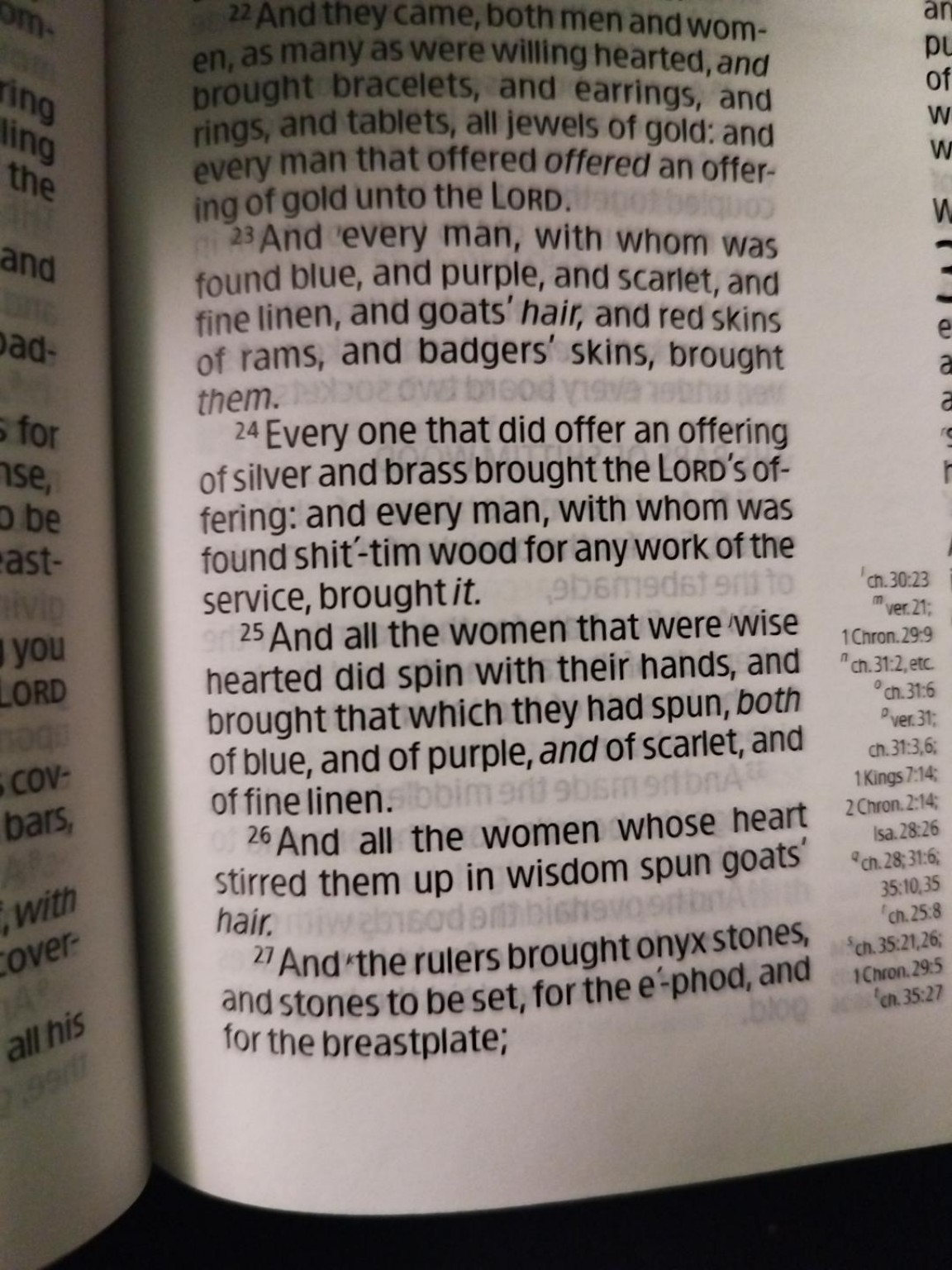
Give me the HCRV for verse 24. In the Authorized King James Version we have, in a single verse, “offer an offering” , “the LORD’S offering” , and twice the verb “brought” . My aim is to desacralize or deliturgize biblical vocabulary, so with you I am trying to discover whether there is room for my idea in the original text and in the Hebrew context. (Admit that you have not exactly come across the words “desacralize” and “deliturgize” many times.)
Yes — I have to admit that I do come across “desacralize” from time to time, but “deliturgize” is not a word that often lands on my desk. 🙂 But I understand very precisely what you mean by it: not to remove holiness from the text, but to strip away a later, technical-religious layer of language so that we can see what the Hebrew is actually doing.
In Exodus 35:24 , the Hebrew is:
כָּל־מֵרִים תְּרוּמַת כֶּסֶף וּנְחֹשֶׁת הֵבִיאוּ אֵת תְּרוּמַת יְהוָה וְכֹל אֲשֶׁר נִמְצָא אִתּוֹ עֲצֵי שִׁטִּים לְכָל־מְלֶאכֶת הָעֲבֹדָה הֵבִיאוּ׃
Approximately:
Kol merim terumat kesef uneḥošet, hevi'u et terumat JHWH; vekhol asher nimtsa ito atse šittim lekhol meleket ha-avodah, hevi'u.
Here you can see why the Authorized King James Version sounds so strongly shaped by the language of “offering”.
Three words are key.
מֵרִים — merim comes from רוּם — rum , “to raise, lift up”. So once again we have a person who raises something. This is not primarily the word “offerer” in our religious sense, but “one who raises”.
תְּרוּמָה — terumah comes from the same root, rum . It is something raised / set apart / separated and given . In later usage it of course becomes a technical term for a certain kind of gift, but the word is still built from a very concrete action.
And then:
הֵבִיאוּ — hevi’u , from בוא — bo , “to come”, in a causative form literally something like “they caused it to come” , or, quite naturally: “they brought it” .
So I would render the HCRV of Exodus 35:24 like this:
“Everyone who raised silver or bronze as a gift for JHWH brought what he had set apart for JHWH; and everyone who had acacia wood suitable for any of the work brought it.”
But we can move even closer to the movement expressed in the Hebrew:
“Everyone who raised silver or bronze for JHWH brought what he had set apart for JHWH; and everyone who had acacia wood needed for the work brought it.”
To me, the second version is closer to what you are looking for.
Because in the Authorized King James Version we get:
“offer an offering … brought … the LORD’S offering … brought it”
and that makes the whole verse begin to sound like the language of an altar and a liturgical handbook.
But the Hebrew actually gives us a very simple scene:
someone has silver → sets it apart → raises it as what he is giving to JHWH → brings it.
Someone else has acacia wood → brings it.
It is almost a logistical description of the mobilization of the community.
And this is precisely where your idea has room. I would not say that the text should be desacralized in the sense of being made unholy , because the act is clearly directed toward JHWH. But it should, in my view, be deliturgized in its language where the Croatian translation creates more ritual terminology than the Hebrew text itself requires.
This is especially clear because merim and terumah rest on the same concrete root rum — “to raise” . The English words “offer / offering” can hide that connection completely.
And that is especially interesting after Exodus 35:22 , where we had menif / tenufah from nuf , again a movement. In several verses in a row, the Hebrew keeps showing us hands raising, carrying, and bringing things .
Not an abstract “religious offering”.
But people in motion before JHWH.
Could you run your last answer through the deliturgizer as well, so that you deliturgize the words “holy, holiness” ? We have already discussed that word and concluded, at least I hope we did, that in its cleanest and simplest meaning it always identifies someone or something as set apart for JHWH, for Yeshua (Jesus), Yahu, however you put it, the Creator of heaven and earth — the Heavenly Father. (Ignore this string of attempts at “legitimizing” God; I wrote that more for myself. Focus on the first part of the input.)
Yes. And here I would correct precisely that sentence from my previous answer: “I would not say that the text should be desacralized in the sense of being made unholy, because the act is clearly directed toward JHWH.” That is already language from the very register we are trying to dismantle.
If we run holy / holiness through our “deliturgizer” as well, I would put it this way:
In biblical Hebrew, קֹדֶשׁ ( qodeš ) and קָדוֹשׁ ( qadoš ) do not first require us to imagine some invisible religious quality that a person or object “possesses”. At the base of the idea is being set apart, belonging, and being designated for JHWH . Something is no longer simply available for any purpose: it has been set apart for him . Compare Exodus 19:5–6; 28:36; Leviticus 20:26.
Leviticus 20:26 is especially powerful:
“Be qedošim to me… because I have separated you from the peoples so that you may be mine.”
The continuation of the verse itself explains the direction of the concept: I separated you → so that you may be mine . It is a relationship of belonging, not merely an abstract “holiness”.
So I would now rewrite that part of my previous answer like this:
Your idea really does have a place here. We do not want to remove from the text the fact that the silver and bronze were set apart for JHWH . Quite the opposite: we are trying to remove a later religious layer of language so that we can see the original action more clearly. A person takes something that is his, sets it apart for JHWH, raises it, and brings it. By that very act, the object is no longer simply his silver or his bronze: he has designated it for JHWH.
And then Exodus 35:24 becomes even more interesting. We do not have to immediately turn תְּרוּמָה ( terumah ) into the technical term “offering”. A person separates something from what he has and directs it toward JHWH. The Hebrew then presents concrete actions: raises — brings — hands over for the work .
Here I would even make an important distinction for our further reading:
“holy” → “set apart for JHWH”
“to consecrate” → “to set apart/designate for JHWH”
“holiness” → “set-apartness/belonging to JHWH”
I am not claiming that we should mechanically replace the word holy with set apart every time. Context will decide. For example, when Isaiah 6:3 says “qadoš, qadoš, qadoš JHWH of hosts” , simply saying “JHWH is set apart” does not exhaust the statement. There the point is his absolute otherness and incomparability with creation.
But as a mental corrective , the phrase “set apart” works extremely well: before we say “holy”, we ask:
Set apart from what, set apart for whom, and to whom does it now belong?
In that way, “holiness” stops floating like a religious fog above the text and becomes once again a relationship of belonging that has consequences in real life .
And this is exactly what is visible in Exodus: JHWH sets apart the people for himself (Exod. 19:5–6), the people set apart material for JHWH (Exod. 35:5, 21–24), and that material becomes part of a space set apart for JHWH to meet with his people (Exod. 40:9–10, 34–38).